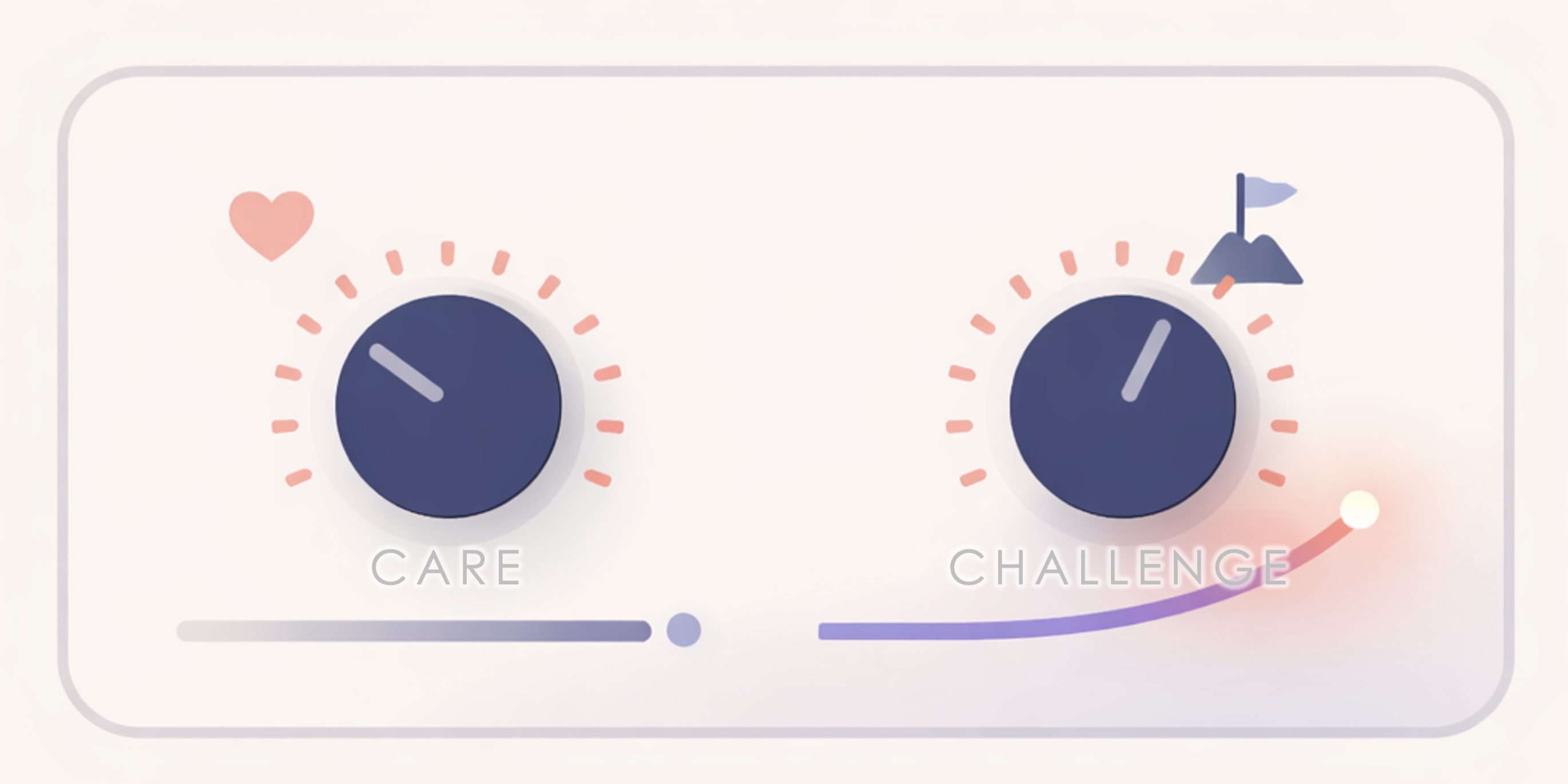
In the last post, we introduced the Care–Challenge Framework: a simple lens for understanding why cultures thrive, stall, or burn out. The core idea is that healthy cultures provide both care (support, trust, belonging) and challenge (standards, stretch, accountability). When those two forces are balanced, they reinforce each other.
In this post, we’ll make the model more usable by mapping it into a simple two-by-two.
If you’re familiar with Kim Scott’s Radical Candor framework, this will look familiar. Scott’s model uses “Care Personally” and “Challenge Directly” to guide feedback and relationships.
We’re borrowing the same axes, but applying them at a different level: the culture of the organisation itself—the patterns and norms that shape how people work together at scale.
Below is the map, with a few familiar companies used as illustrative examples drawn from public reporting, highlighting patterns from particular moments and contexts (not as a final verdict on any of their cultures).
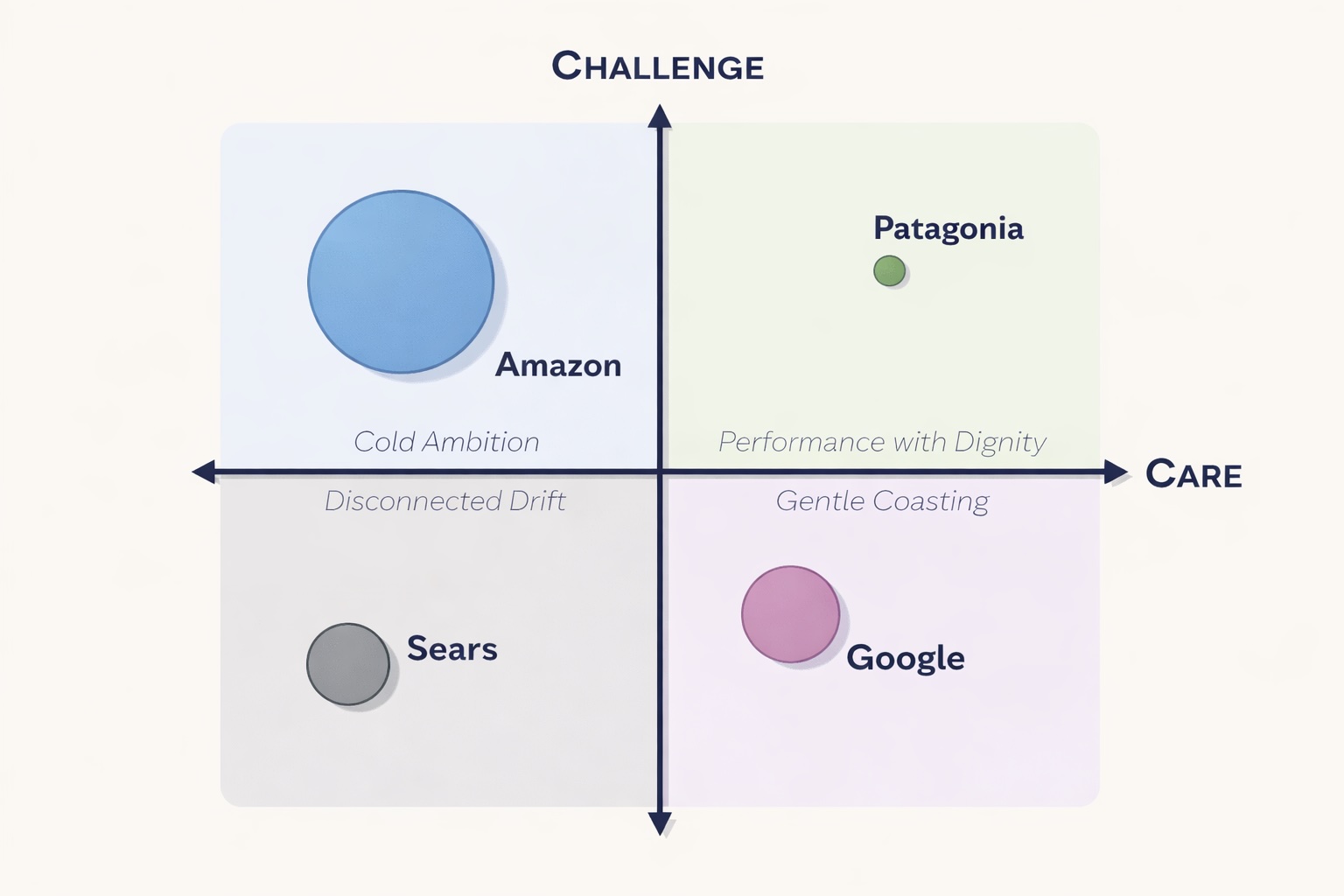
The axes
Care (horizontal axis) isn’t about perks. It’s the extent to which the culture communicates: “You matter here.” People experience fairness, listening, psychological safety, and support—especially when things get hard.
Challenge (vertical axis) isn’t about being harsh. It’s the extent to which the culture communicates: “We expect your best.” People experience clarity, standards, accountability, honest feedback, and a shared push toward meaningful goals.
When you combine these two, you get four common cultural “profiles.” They’re not personality types, and real companies can sit in different quadrants in different teams. The point is diagnostic: it helps leaders quickly see what’s missing.
1) High Care + High Challenge: “Performance with Dignity”
This is the sweet spot. People feel valued and supported, and they’re also expected to deliver, stretch, and tell the truth. Candour is normal. Accountability is consistent. Performance doesn’t come at the expense of humanity—it’s enabled by it.
You’ll often see:
-
Direct feedback that still feels respectful
-
Clear standards and follow-through
-
High learning velocity (mistakes discussed early, not hidden)
Illustrative example (imperfect, but useful): Patagonia
Patagonia is widely known for employee-supportive practices (e.g., family benefits and on-site childcare) alongside an unusually demanding mission and values-driven standards (“we’re in business to save our home planet,” and explicit accountability in its values).
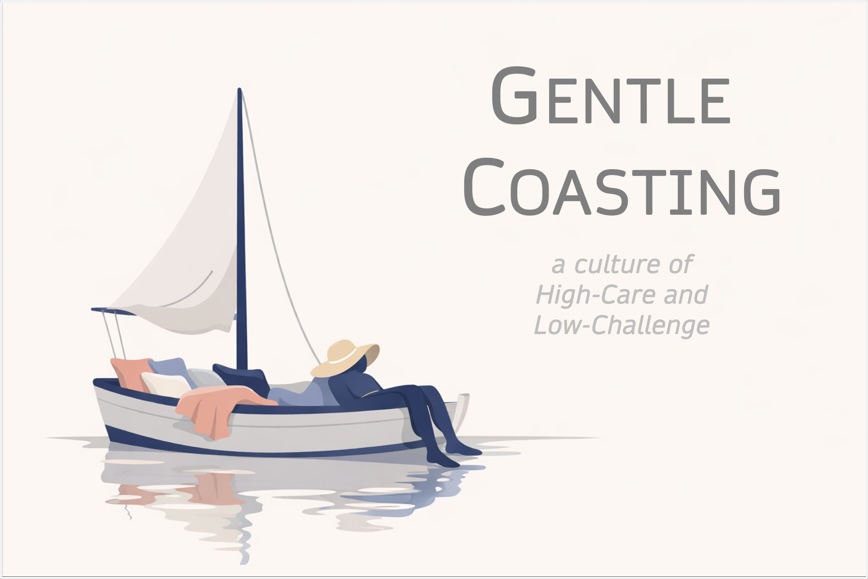
2) High Care + Low Challenge: “Gentle Coasting”
This is where good intentions drift into low standards. People are cared for, conflict is avoided, and accountability becomes inconsistent. It can feel pleasant day-to-day, but over time it becomes costly: decisions slow down, hard truths don’t surface, and high performers quietly disengage.
You’ll often see:
- Feedback that’s vague or softened
- Underperformance tolerated “because we’re kind”
- Meetings with harmony—but not much truth
Illustrative example (as a “scale drift” pattern): Google
Google is well known for robust employee benefits and support systems. At the same time, multiple reports/insiders in recent years have described bureaucracy, internal fragmentation, and slower decision-making—dynamics that can show up when “care” remains strong but “challenge” (clarity, urgency, hard prioritisation) becomes harder to sustain at scale.
(Important caveat: this doesn’t mean Google is “low challenge” everywhere; it’s an example of how scale can pull a culture toward this quadrant.)
3) Low Care + High Challenge: "Relentless Efficiency"
This is a high-demand environment without enough psychological safety or support. The organisation pushes hard, but doesn’t reliably protect people’s dignity, workload sustainability, or basic sense of being valued. Performance may spike in the short term, but the long-term pattern is brittleness: burnout, fear, politics, turnover, and degraded collaboration.
You’ll often see:
- People working at breakneck pace, quietly depleted
- Blame, fear, or harsh “standards” without coaching
- Reduced collaboration and learning (everyone protects themselves)
Illustrative example: Amazon (as reported in 2015)
The New York Times reported a “bruising workplace” dynamic at Amazon, describing intense pressure and harsh management practices in some contexts, followed by a public internal response from Jeff Bezos disputing that depiction and urging escalation of callous incidents.
(Again: this is a public snapshot from a specific period and set of reports, not a permanent label.)
4) Low Care + Low Challenge: “Disconnected Drift”
This is the most corrosive quadrant because it combines disengagement with disconnection. There’s little support, little inspiration, and little sense of standards that matter. Communication thins out. People feel in the dark. “Us vs. them” takes hold. The culture can become cynical, political, and increasingly hollow.
You’ll often see:
- Minimal clarity, minimal follow-through
- Leaders out of touch and employees checked out
- Infighting, fragmentation, and low belief in the future
Illustrative example (late-stage decline pattern): Sears
In analyses of Sears’ decline, reporting has described internal fragmentation and infighting (including a “warring divisions” structure), alongside deteriorating conditions and widespread employee frustration as the company shrank dramatically.
Two quick notes before you place your organisation in a box
First: these aren’t identities. They’re patterns. Most organisations are mixed—different functions can sit in different quadrants.
Second: the model is useful because it points toward the fix. If you know what’s missing, you know what to turn up:
- If care is low → build trust, fairness, listening, psychological safety, support.
- If challenge is low → build clarity, standards, ownership, candid feedback, follow-through.
- If both are low → focus on trust and transparency (or simply call us)
What’s next
In the next posts, we’ll dive into each quadrant in depth—how it shows up day-to-day, what it costs over time, and practical ways to rebalance without losing what’s already good.