When Challenge and Care both go missing
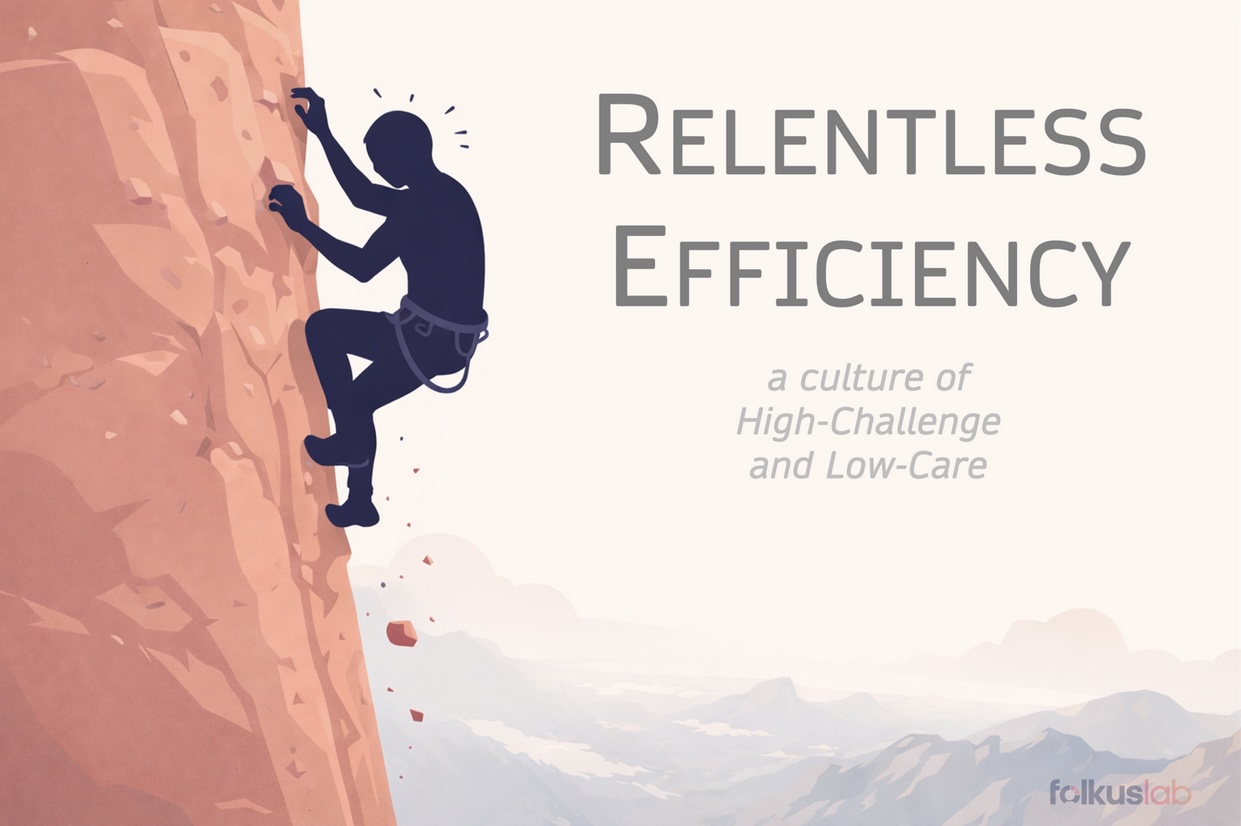
Most culture problems are about imbalance: too much challenge without enough care, or too much care without enough challenge.
But there’s one profile that feels different. Not unbalanced, just no longer doing its job. Offline.
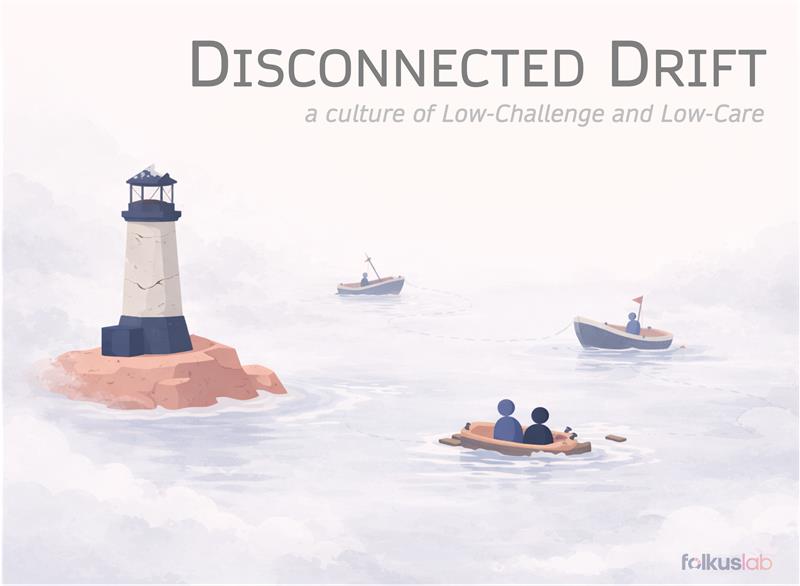
In this quadrant of low care, low challenge, culture stops functioning as a shared system of meaning and coordination. The healthy signals that normally hold a company together (support, trust, direction, accountability) weaken or disappear. The result is what we call Disconnected Drift.
This post is the next in our Care–Challenge series, and it explores what this pattern looks like, why it happens, and what it takes to bring the culture back online.
What is a low-care, low-challenge culture?
At its core, this isn’t just “low morale” or “low performance.” It’s something more structural.
A low-care, low-challenge culture is what happens when:
- care signals fade (trust, dignity, connection, recognition, psychological safety), and
- challenge signals fade too (clarity, standards, accountability, direction, honest feedback).
When both are missing, people don’t experience a coherent organisation. They experience pockets of teams and local realities with little shared glue across the whole.
An “us vs them” mindset is often a key indicator. When people stop assuming leadership is acting in the shared interest, and start interpreting decisions as something being done to them, not with them.
As a result of this fragmentation, the culture stops acting like a living system. It stops reinforcing shared norms. It stops creating shared meaning. It becomes (quite literally) hard to know what the organisation stands for anymore.
How it develops: the severing of connection
In our experience, this profile often emerges after a serious breakdown in vertical trust, between leadership and the rest of the organisation.
Think of it like a lighthouse that’s stopped doing its job. The light might still flash, but it’s inconsistent, mistimed, or pointing the wrong way. People stop using it to navigate. So leaders’ messages stop landing. Employees stop believing them. Middle layers stop translating them. And the feedback loop that usually keeps norms alive starts to fail.
One client in the aviation sector described it bluntly: after a series of decisions perceived as profit-first and people-last, many employees stopped believing leadership had their interests at heart. care dropped. But so did challenge. People didn’t experience a clear vision, consistent standards, or meaningful accountability… just distance and disconnection.
Over time, the organisation wasn’t guided by anything. It was simply adrift.
How it shows up day-to-day
Disconnected Drift is often surprisingly uneven. That’s part of the risk: it becomes hard to predict what you’ll find from one area to the next.
Common signs include:
- Fragmentation and silos: collaboration across teams becomes slow, brittle, or non-existent.
- ‘Us vs them’ narratives: leadership decisions are read through suspicion; rumours fill the gap; “they” becomes a shorthand for distance, unfairness, or threat.
- Local “survival cultures”: people rely heavily on their immediate team, sometimes forming strong internal bonds as a coping mechanism.
- Low trust and “covering yourself”: self-protection rises, candour drops, and politics creep in.
- Weak clarity and weak follow-through: priorities conflict, goals are fuzzy, deadlines slip, and consequences are inconsistent or absent.
- A widening gap between leadership narrative and lived experience: messages may still be sent, but they don’t land.
Ironically, you may still find “healthy” pockets, in the form of teams that create their own mini-cultures of care or standards. But that’s not the organisation working; it’s people compensating for the absence of a shared system.
Why it’s the highest-risk quadrant
Most organisations exist for one reason: to coordinate human effort toward a shared outcome.
Disconnected Drift undermines that basic purpose.
When culture goes offline:
- collaboration breaks down,
- coordination becomes unpredictable,
- performance becomes uneven and fragile,
- and quality, customer experience, and talent retention all suffer.
This is why organisations in this quadrant can feel chaotic - not loud chaos, necessarily, but a quiet kind: misalignment, confusion, distrust, disconnect.
If you also have weak local leadership in a pocket of the business, there’s often nothing to buffer it. In stronger cultures, people can sometimes “survive” a bad manager because the wider system reinforces healthier norms. Here, the system doesn’t protect you.
Can it be turned around?
Often, yes, but it requires something different than incremental culture initiatives.
This quadrant typically demands a reckoning: an honest acknowledgement that the social contract has been damaged and that trust has deteriorated. Without that acknowledgement, attempts to “roll out values” or run engagement campaigns can backfire and deepen cynicism.
Turning it around usually starts with leadership doing three things in sequence:
-
Name the rupture (honestly). Acknowledge what people have experienced, where the disconnect is, and what has eroded trust. If an ‘us vs them’ perception has taken hold, name it specifically. If leaders don’t address it directly, people assume it’s either true or untouchable.
-
Rebuild credibility through visible behaviour. Not through slogans, posters, or a ‘values refresh,’ but through consistent actions: transparency, accountability, follow-through, and a renewed willingness to listen and respond.
-
Re-establish shared direction and standards. Once care and trust begin to return, challenge can be reintroduced: clearer expectations, aligned priorities, and the basics of accountability that make coordination possible again.
This process requires humility and real courage. But it can also be transformational; not just for the organisation, but for leaders themselves. It’s a ripe opportunity to evolve one’s leadership in real-time. Cultures like this don’t change through technique. They change through truth.
A practical takeaway
If your culture is drifting toward this corner, the goal is to get the culture system back online and working for you rather than against you.
- restore vertical connection
- restore credibility
- restore shared meaning
- and then rebuild consistent care signals (“you matter”) and challenge signals (“the work matters”).
The earlier you catch Disconnected Drift, the easier it is to reverse. Left unmanaged, mistrust deepens, silos harden, and drift accelerates.
Closing
If you recognised your organisation in some of the patterns above, we’re happy to talk. A short conversation is often enough to sense-check where you are on the Care–Challenge map and what it would take to rebuild connection and clarity.
And if you’re following along, the next (and final) post in this series will cover the sweet spot: High Care, High Challenge: how it works, how it’s sustained, and how to build it intentionally.